
The challenge is rarely the quality of the content itself, but how development is structured and supported over time.
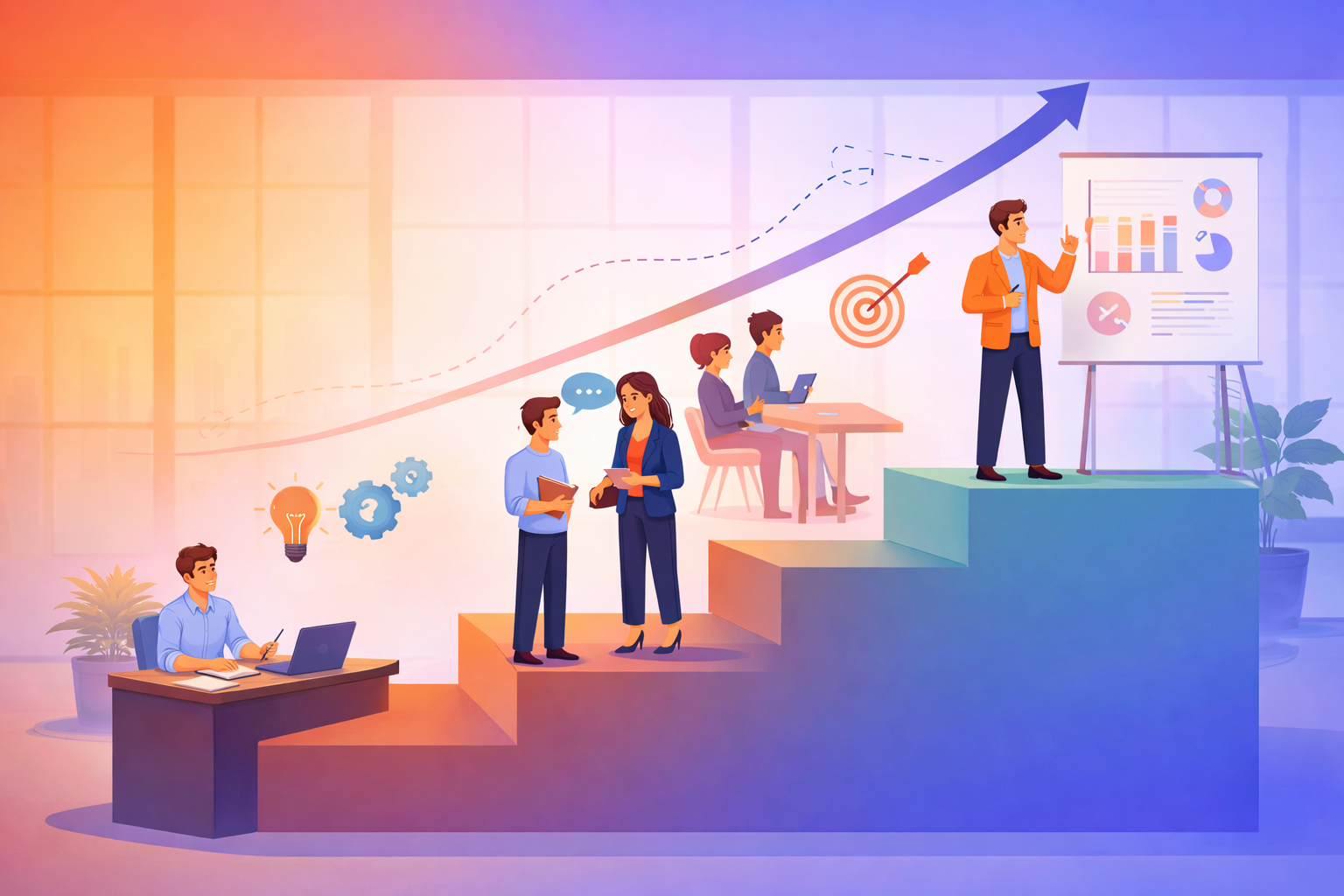
Development happens in the work, not away from it
Emerging leaders develop most effectively when learning is closely connected to their real responsibilities. While workshops and formal inputs can introduce valuable ideas, capability is strengthened through application.
This means having opportunities to:
- Try new approaches in live situations
- Reflect on what worked (and what didn’t)
- Adjust behaviour over time
Without this, learning can remain theoretical. With it, leadership begins to take shape through experience.
However, individuals cannot do this alone. The environment around them — and particularly their line manager — plays a critical role in whether development sticks.
The role of the line manager
Line managers are one of the most powerful influences on leadership development, yet their role is often underutilised.
When actively involved, line managers can:
- Reinforce key messages from development programmes
- Provide timely, relevant feedback based on observed behaviour
- Create space for reflection through regular conversations
- Encourage individuals to step forward and take on new challenges
In many ways, they act as the bridge between learning and application.
Without this support, emerging leaders may attend development sessions but return to environments where little changes. Old habits persist, and new behaviours are not fully embedded.
With it, development becomes part of how work happens.

Creating the conditions for growth
Organisations that develop leaders effectively tend to create a wider ecosystem of support around the individual.
This often includes:
- Structured development inputs to build awareness and introduce new perspectives
- Coaching to deepen reflection and support behaviour change
- Opportunities within the role to practise leadership in real situations
- Ongoing feedback from both managers and stakeholders
Crucially, these elements are connected — not separate.
For example, an individual might explore communication in a development session, practise this in a team meeting, reflect on the outcome in coaching and then discuss it with their line manager. Over time, this cycle strengthens both confidence and capability.
From learning to behaviour
One of the key differences between effective and ineffective development is whether it translates into observable behaviour.
Emerging leaders need to move beyond knowing what good leadership looks like, to consistently demonstrating it in practice. This includes:
- Communicating with clarity and confidence
- Building strong, trusted relationships
- Making decisions with sound judgement
- Influencing others, even without formal authority
These capabilities are not developed overnight. They require repetition, feedback and adjustment over time.
Line managers are central to this process because they are best placed to notice these shifts as they happen — and, when supported with the right structure and guidance themselves, to actively reinforce them.

A more integrated approach
At LUMA, leadership development is designed as an ongoing process rather than a single intervention. Programmes combine insight, coaching and real-world application, with a strong emphasis on line manager involvement.
Managers are encouraged to play an active role throughout the journey — not as observers, but as partners in development.
This ensures that learning does not sit outside the organisation, but is embedded within it.
Bringing it together
Developing emerging leaders effectively is less about delivering more content, and more about creating the right conditions for growth.
When development is supported over time, grounded in real work and reinforced by engaged line managers, individuals are far more likely to build lasting capability.
And ultimately, it is this combination — not a single course or intervention — that enables emerging leaders to grow into confident, credible and effective leaders.