
While these experiences can introduce useful ideas and frameworks, leadership capability rarely develops through training alone. In practice, leadership grows through experience.

Connecting Development to Real Situations
One of the most effective ways to embed leadership development is by encouraging individuals to reflect on real situations they encounter in their role.
Leadership rarely unfolds in theoretical scenarios. Instead, leaders must respond to complex and often unpredictable circumstances — a difficult team conversation, a decision with incomplete information, or a moment where someone needs support or guidance.
By encouraging individuals to pause and reflect on these experiences, organisations help leaders develop deeper awareness of how they think, respond and influence others.
Simple reflective questions can be powerful:
- What happened in that situation?
- What influenced my response?
- What might I approach differently next time?
These small moments of reflection allow everyday work to become a source of ongoing learning.
Encouraging Ongoing Conversations
Leadership development also becomes embedded when it forms part of regular conversations.
Line managers play an important role here. Rather than focusing solely on tasks and performance outcomes, leaders can use one-to-one meetings to explore broader development questions.
For example:
- What leadership challenges are you currently facing?
- What have you learned from recent experiences?
- Where would you like to grow over the coming months?
These conversations help individuals connect their day-to-day responsibilities with their development as leaders.
They also reinforce the idea that leadership growth is not something that happens occasionally, but something that evolves continuously.


Creating Opportunities to Practise Leadership
Leadership capability strengthens through practice.
Organisations can support this by giving individuals opportunities to take on responsibilities that stretch their thinking and broaden their experience. This might involve leading a project, facilitating a team discussion, or taking ownership of a new initiative.
These experiences allow individuals to experiment with different leadership behaviours while still within the context of their normal role.
Importantly, this kind of development does not require large structural changes. Often it is the gradual expansion of responsibility and decision-making that helps individuals build confidence and capability over time.
Building Reflection and Feedback Into the Workflow
Many organisations operate at a fast pace, which can make it difficult for individuals to pause and reflect. However, small moments of reflection and feedback built into the workflow can make a significant difference.
After a key meeting, presentation or decision, leaders might briefly ask themselves:
- What worked well?
- What did I notice about how others responded?
- What might I try differently next time?
Alongside personal reflection, feedback from others can provide valuable insight. Sometimes the way we experience our own leadership is different from how others experience it.
Simple questions to colleagues or team members such as:
- How did that meeting work from your perspective?
- Was there anything I could have done differently to support the discussion?
- Did the outcome feel clear and helpful?
can help leaders gain a broader understanding of their impact.
These reflections and feedback conversations do not need to be lengthy or formal. Even small moments of learning within everyday work can help individuals recognise patterns, strengthen their awareness and gradually refine how they lead.
Over time, this combination of reflection and feedback becomes a powerful development tool, helping leaders translate experience into meaningful growth.

Supporting Learning Over Time
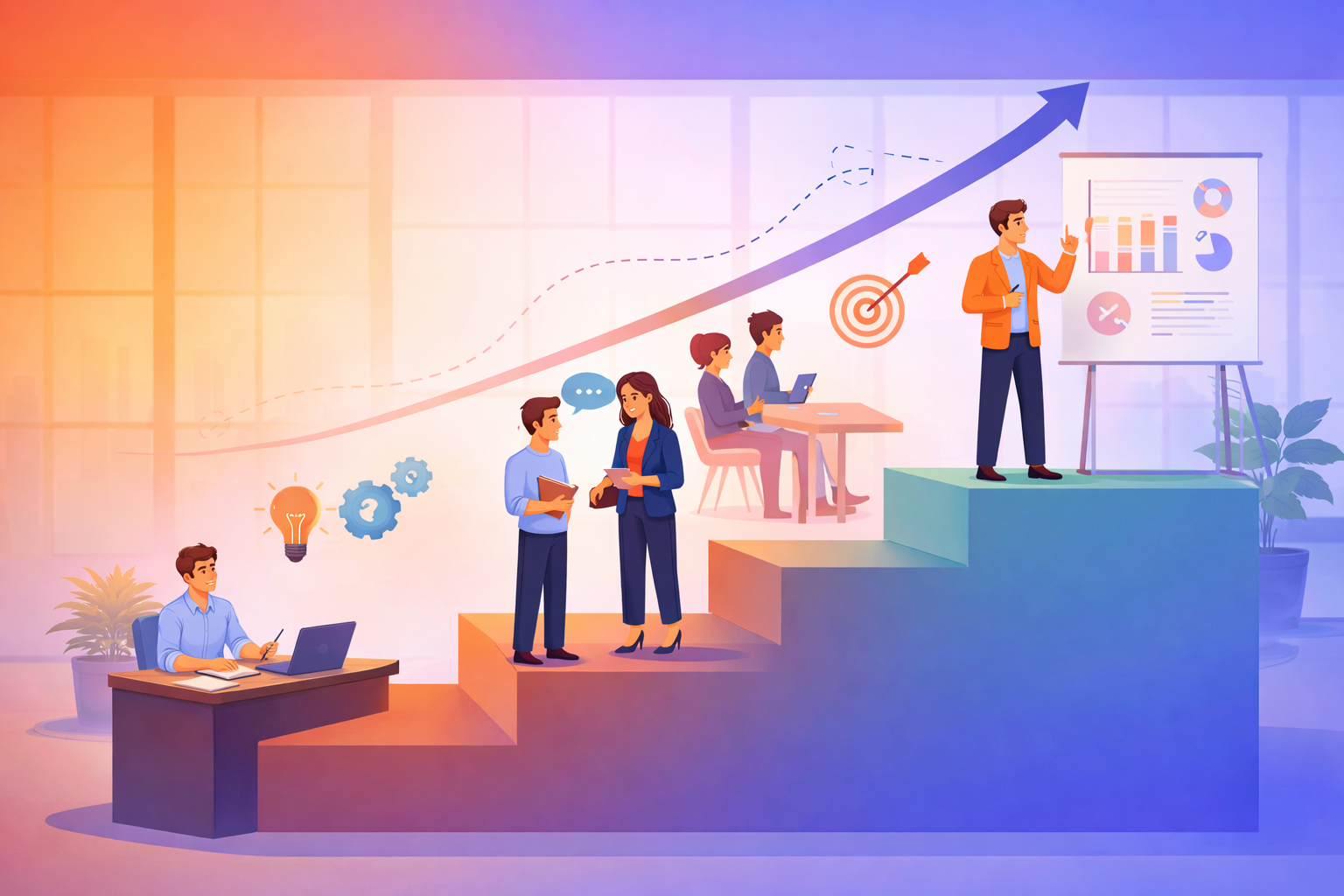
Leadership development is most effective when it takes place over time rather than as a one-off experience.
Embedding development into day-to-day work allows individuals to continually test ideas, learn from outcomes and refine their approach. Each experience builds on the previous one, gradually strengthening leadership capability.
This ongoing process helps individuals develop insight that feels directly connected to their role and responsibilities.
As a result, leadership development becomes less about attending a programme and more about how people think, communicate and make decisions in their everyday work.
Leadership Development as Part of the Culture
When leadership development is embedded in this way, it gradually becomes part of the organisational culture rather than something that sits alongside everyday work.
Reflection, feedback, learning and growth are no longer separate activities but natural elements of how people work together. Conversations about development become more common, and leaders begin to view everyday situations as opportunities to learn and improve.
In these environments, individuals do not simply attend leadership programmes and then return to business as usual. Instead, they continue developing as leaders through the experiences, conversations and challenges they encounter every day.
Meetings, decisions and team interactions all become moments where leadership capability can strengthen. Over time, these repeated opportunities for reflection, feedback and experimentation help individuals build greater confidence and awareness in how they lead.
It is through this steady and continuous process that leadership capability truly grows.