
Technical expertise may have been the foundation of their success, but leadership requires something more complex: the ability to work through others, navigate relationships and make sound decisions in increasingly uncertain environments.

Leading Self: awareness, judgement and intention
The starting point for any emerging leader is self-awareness. High performers are often promoted because of their strengths — but those same strengths can become limitations if overused, particularly under pressure.
Leaders need to recognise when they are defaulting to familiar behaviours and develop the ability to adjust. This includes maintaining composure under pressure, understanding personal values and being able to articulate a clear leadership style.
In practice, this looks like a shift from:
“This is just how I am” to “I can choose how I show up.”
Leaders who develop this awareness are more adaptable, more consistent and better able to make considered decisions when it matters most.
Leading Others: relationships, communication and influence
As leadership responsibility increases, success depends less on individual contribution and more on relational impact.
Emerging leaders must build strong, trusted relationships, communicate with clarity and develop others around them. This includes handling difficult conversations, listening actively and adapting communication to different audiences.
One of the most critical capabilities is the ability to influence without authority. In modern organisations, leaders often need to work across functions, align stakeholders and shape outcomes without relying on positional power.
This requires credibility, empathy and clarity of thinking.
Over time, leaders begin to move from:
“I hope people trust me” to “I understand how trust is built — and I act accordingly.”
And from:
“I don’t have authority over them” to “I can influence through credibility and clarity.”


Leading the Business: perspective, change and complexity
Beyond self and others, emerging leaders must also develop a broader organisational perspective.
This includes thinking strategically, contributing beyond their immediate role and understanding how decisions impact the wider system. As environments become more complex and fast-changing, leaders also need to navigate ambiguity and lead through uncertainty.
Rather than waiting for perfect information, effective leaders learn to make progress with incomplete data, communicate clearly during change and remain steady when plans shift.
They begin to move from:
“That’s not my area” to “How can I contribute to the bigger picture?”
And from:
“I need certainty before I act” to “I can move forward thoughtfully, even when things aren’t clear.”
From skills to behaviour
While these capabilities are often described as “skills”, what matters most is how they translate into everyday behaviour.
Research consistently shows that leadership effectiveness is not driven by knowledge alone, but by the ability to apply that knowledge in real situations — through reflection, feedback and experience over time.
This is why leadership development cannot rely solely on one-off training events. It must be embedded into day-to-day work, where individuals can test new approaches, learn from outcomes and gradually strengthen their capability.

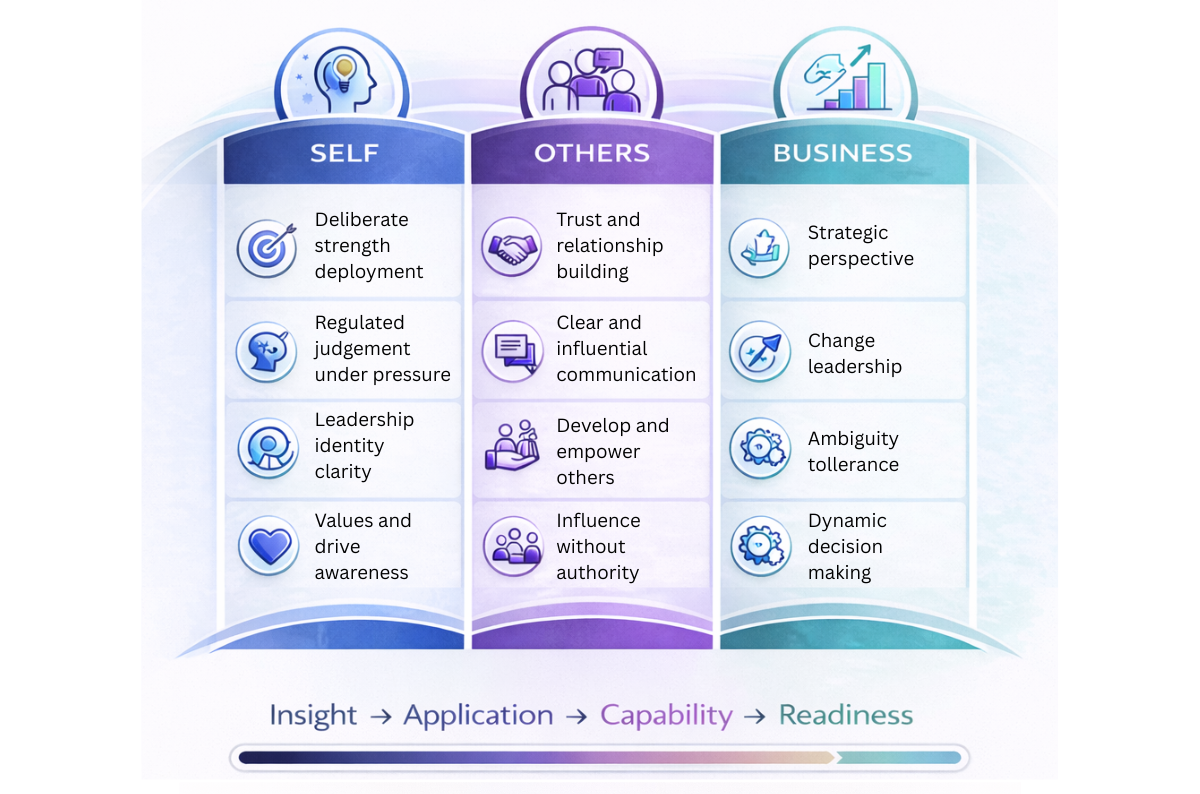
Bringing it all together
The most effective emerging leaders are not those who excel in one area alone, but those who develop balance across Self, Others and Business.
They understand themselves, work effectively with others and think beyond their immediate role.
And importantly, they recognise that leadership is not something they attend — it is something they practise, every day.
👉 For a deeper exploration of how these capabilities develop over time, see the full article on The LUMA Leadership Readiness Model.