In many organisations, individuals are promoted because they are technically strong, reliable and consistently deliver results. While these qualities matter, they are rarely enough on their own to prepare someone for leadership.

Growing self-awareness
One of the earliest indicators of leadership readiness is self-awareness.
Individuals begin to recognise how their behaviour impacts others and how their natural strengths can both help and hinder them. Rather than operating on instinct alone, they start to pause and choose how they respond.
For example:
After a meeting, they reflect: “I noticed I pushed my view quite strongly — did that shut others down?”
In a pressured situation, they catch themselves before reacting and ask: “What response would be most helpful here?”
This shift from automatic reaction to intentional behaviour is a critical step towards leadership.
The ability to build strong relationships
Leadership is fundamentally relational. As individuals become ready for leadership, they begin to place more focus on how they work with others, not just what they deliver.
This often shows up in small but important ways:
- Taking time to understand different perspectives before making a decision
- Adapting communication style depending on the individual or situation
- Following up after a challenging conversation to maintain trust
For instance, rather than avoiding a difficult conversation, a ready leader might say:
“Can we talk about how that landed in the meeting earlier? I’d like to understand your perspective.”
These behaviours build trust and create the conditions for effective collaboration.


A shift from doing to enabling
A key transition point is moving away from solving every problem personally.
Emerging leaders who are ready begin to step back and involve others more deliberately. They recognise that their role is not to have all the answers, but to create the space for others to contribute.
In practice, this might look like:
- Asking “What do you think we should do?” instead of providing the solution
- Delegating a piece of work and resisting the urge to step back in too quickly
- Supporting someone else to present their ideas, rather than doing it themselves
Over time, their focus shifts from personal output to strengthening the capability of the team.
Sound judgement in uncertain situations
Leadership often involves making decisions without complete information. Individuals who are ready for leadership begin to show comfort with this ambiguity.
They are able to:
- Weigh different perspectives before acting
- Make progress without waiting for perfect clarity
- Stay calm when plans change or pressure increases
For example, instead of delaying a decision, they might say:
“We don’t have all the data, but based on what we know, this feels like the right next step. Let’s test it and review.”
This demonstrates both judgement and confidence.


Awareness of the wider business context
Leadership readiness also involves thinking beyond one’s immediate role.
Individuals start to connect their work to the broader organisation — understanding priorities, recognising trade-offs and considering how decisions impact others.
This might show up as:
- Asking “How does this affect the wider team or function?”
- Contributing ideas in meetings beyond their immediate remit
- Showing curiosity about how different parts of the organisation operate
This broader perspective is essential as leadership responsibility grows.
Bringing it together
Leadership readiness is not about having all the answers or feeling completely confident. In many cases, individuals feel some uncertainty — and that is entirely normal.
What matters more is the direction of travel.
Are they becoming more aware of themselves?
Are they building stronger relationships?
Are they beginning to step back and think more broadly?
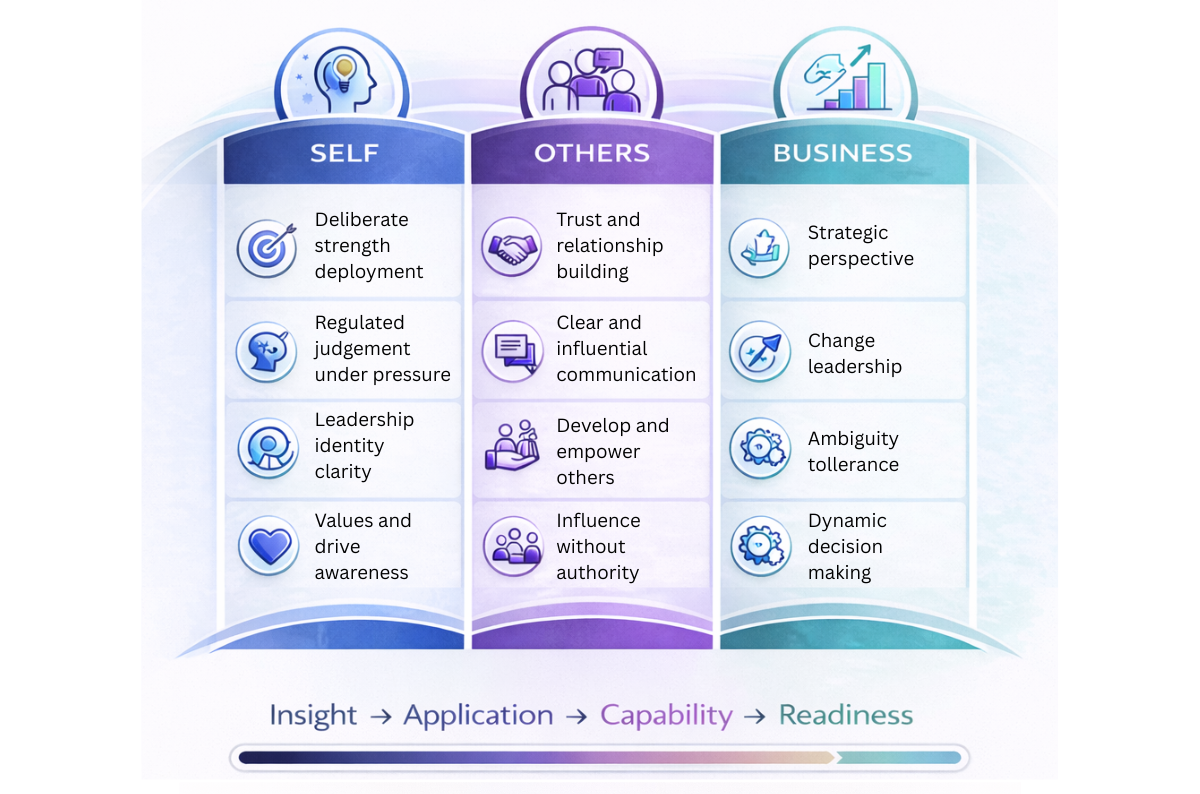
At LUMA, the Leadership Readiness Model brings these elements together through three interconnected areas: Self, Others and Business.
When individuals begin to develop across all three, leadership capability starts to emerge in a way that feels both authentic and effective.
And ultimately, leadership readiness is not a single moment — it is a gradual shift in how someone thinks, behaves and shows up in their role every day.