
Yet for many individuals, the transition feels far more difficult than expected. This is because leadership requires a fundamentally different set of skills and responsibilities from those that helped them succeed previously.
In many cases, individuals are promoted because of their technical expertise or their ability to deliver results independently. They are used to being the person with the answers, solving problems directly and taking ownership of outcomes. However, leadership shifts the focus away from personal output towards enabling others.
This is where the challenge begins.

From doing to leading
One of the most significant shifts for new leaders is moving from doing the work to leading through others. Rather than being responsible for every detail, they are now expected to create the conditions where others can contribute and perform at their best.
This can feel uncomfortable.
Many new leaders find themselves caught between two identities — wanting to step back and lead, but also feeling the urge to stay close to the work where they feel most confident. As a result, they may hold on too tightly, struggle to delegate or step in too quickly to solve problems.
Over time, this can limit both their effectiveness and the growth of their team.
Increased visibility and pressure
Alongside this shift in responsibility comes increased visibility. Decisions carry greater impact, behaviours are more closely observed and expectations are often less clearly defined.
New leaders are expected to:
- Manage relationships with a wider range of stakeholders
- Influence decisions without always having formal authority
- Handle difficult conversations with confidence
- Maintain composure under pressure
Without the space or support to develop these capabilities, it is not uncommon for individuals to experience uncertainty, self-doubt or a sense of pressure to prove themselves.


The hidden challenge: identity
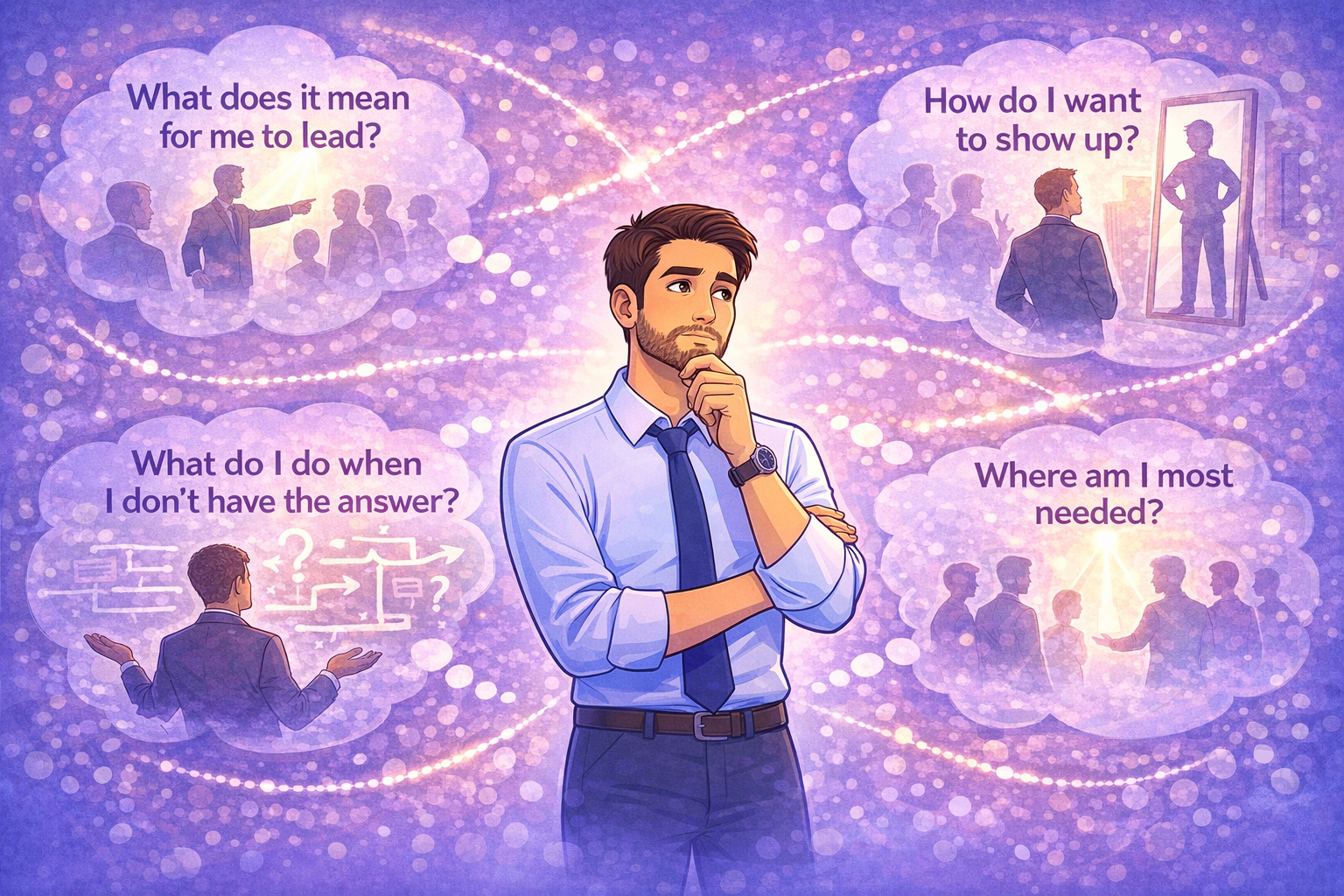
What is often less visible — but equally important — is the internal shift that leadership requires.
Becoming a leader is not just about learning new skills; it is about developing a new way of thinking about yourself and your role.
Questions begin to surface:
- What does it mean for me to lead?
- How do I want to show up?
- What do I do when I don’t have the answer?
Without clarity in this area, behaviour can feel inconsistent or reactive, particularly in challenging situations.
Why support matters
Despite the complexity of this transition, many individuals receive limited structured support when they first step into leadership roles. They are expected to learn “on the job”, often in fast-paced environments where time for reflection is scarce.
While experience is essential, experience alone is not always enough to drive effective development.
Research consistently shows that leadership capability strengthens when individuals are able to:
- Reflect on their experiences
- Receive feedback on how they are perceived
- Experiment with different approaches in real situations
- Build awareness of how their behaviour impacts others
Without this, it is easy to fall back into familiar habits — even when those habits no longer serve the role.

A more effective approach
Structured leadership development can play a critical role in easing this transition.
By creating space for reflection, increasing self-awareness and focusing on real workplace application, individuals begin to develop the capabilities required to lead effectively. They learn not just what good leadership looks like, but how to apply it in their own context.
Over time, this helps leaders move from:
“I need to prove myself through what I deliver”
to
“My role is to create the conditions for others to succeed.”
Bringing it together
The transition into leadership is not always straightforward — and it is not a sign of weakness to find it challenging. In many ways, it is a natural and necessary part of growth.
With the right support, reflection and experience, new leaders can navigate this shift more confidently and develop the awareness, relationships and judgement needed to lead with real impact.
And ultimately, it is through this process — not a single promotion — that leadership capability truly develops.